

Baltimore County's Interdepartmental Meetings on Data Centers
Faith Klareich, founder of DCAG-MD, explains the environmental realities of data centers—and why communities must be central to the planning process.

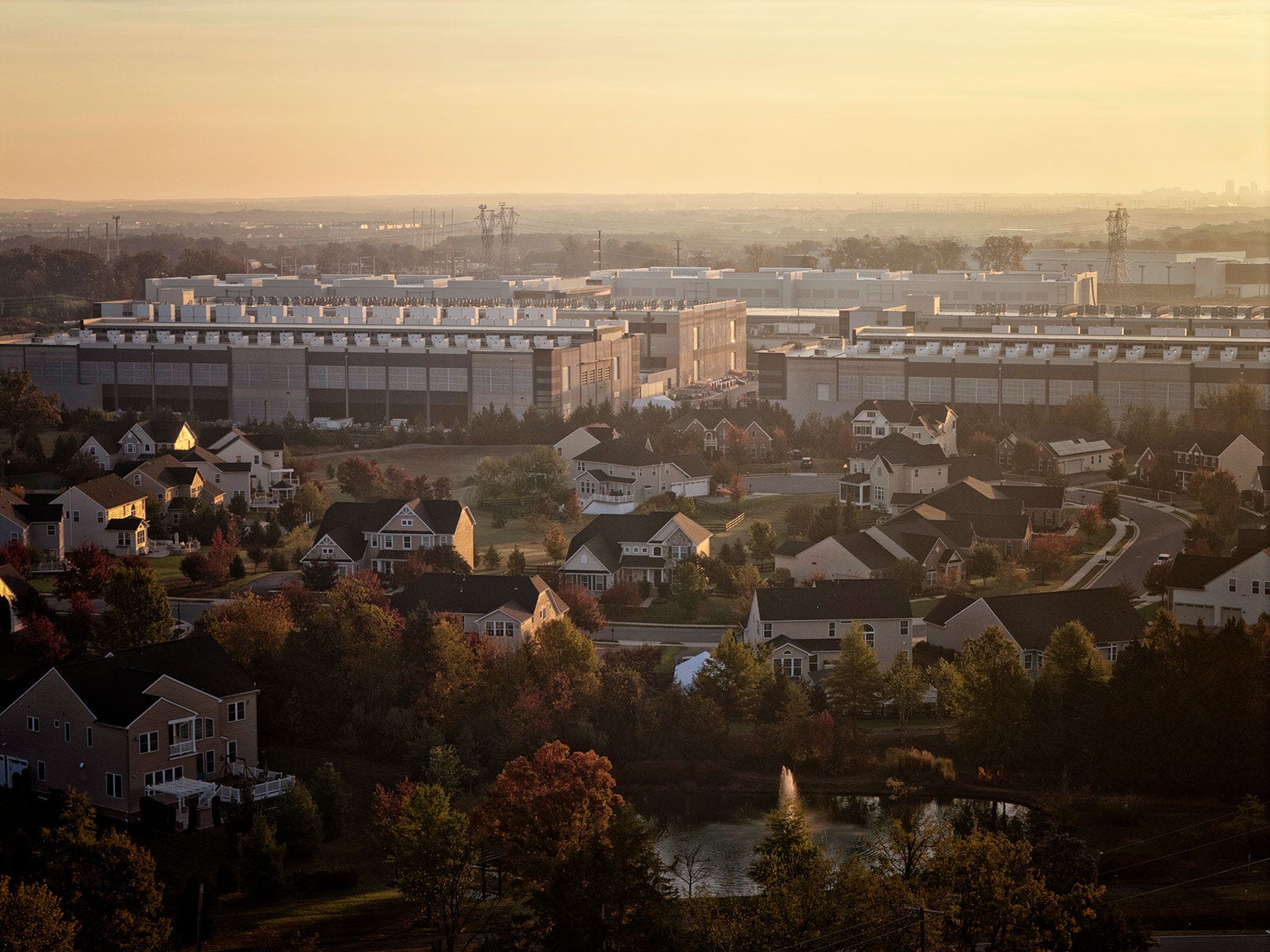
A race to build massive data centers, along with the towering transmission lines and sprawling substations needed to run them, is rapidly reshaping the American landscape. But as public backlash mounts, local officials nationwide are suspending development to weigh the implications.
In Woodlawn, a proposed 150-megawatt data center has raised alarms about constant noise, the strain on water and energy supplies, and higher utility costs.
The Baltimore County Council passed a bill temporarily pausing new data center development while an interdepartmental working group evaluates the economic and infrastructure impacts. The group is also drafting recommended regulations and bringing in guest presenters to gain insight into an industry often hidden behind non-disclosure agreements.
One of those presenters was Faith Klareich, a clean energy policy expert with four decades of experience advising agencies like the EPA and the Department of Energy. She recently chaired Frederick County’s Sustainability Commission and was appointed by the County Executive to the Frederick County Data Centers Workgroup held during its own temporary hold on data center zoning map amendments. Not one to simply toe the line, Klareich wrote two formal dissents to her county’s final report, one pushing for a public-private partnership that puts the community directly at the negotiating table. She later founded the Maryland Data Centers Analysis Group (DCAG-MD), drawing on lessons learned in Frederick County to help other counties navigate similar challenges. She recently spoke with me about the importance of having a “visioning exercise”, the environmental costs, and why these hyperscale data center projects should no longer be planned behind closed doors.
This interview has been edited for length and clarity.
Thank you so much for meeting with me. I have so many questions about hyperscale data centers. I think it’s a good thing for the county to pause, study the impacts, and put this internal working group together. Right now, everyone is trying to understand how these data centers operate and exactly how much energy and water they consume. To start, could you tell me a bit about your background?
I have a 40-year career in clean energy technologies and was involved almost from the very beginning. My graduate school education and some of my undergraduate work was on energy and technology management. Throughout my career, I’ve worked with the DOE, EPA, Interior, Transportation, and a number of states on these kinds of policies.
Living here in Frederick, I was chairing the Sustainability Commission when the county executive established a moratorium and a task force to study the impacts of data centers. I served on the sustainability subcommittee work group, focusing on noise. Given my interest in energy, I also looked at how jurisdictions around the country formulate policy mechanisms to incentivize certain (sustainable) outcomes with these buildouts.
You can still find our report on the Frederick County Government website. I wrote a couple of dissents, including one on community benefits—which I feel people don’t talk about enough. In Maryland, case law has tied community benefits to zoning and land use. This means county governments can’t really engage in community benefit discussions until all the zoning, siting, and permitting has happened.
I believe a portion of the community benefits discussion should take place earlier in the development process and in doing so, consider a public-private partnership targeting resource management issues with those funds. If we focus on resources, then we can perhaps divorce it from land/zoning issues. Stakeholders and the community should be at the table with the industry. The government can be there too, but if it’s strictly a government-industry arrangement, it becomes divorced from the public. In this way, we can assure that some portion of funds address community clean energy initiatives.
Regarding impacts, there is a whole planning process that counties are simply not undertaking. It’s great to know best practices and impacts, but what’s the context, and how are you deploying them? When I chaired the Environment Commission in Rockville, I saw that stormwater plays out differently in every neighborhood. Similarly, if they build a data center here in Adamstown, the rest of the county is still going to feel the impacts on energy costs, water, and possible brownouts. We may not have sufficient electricity delivery in certain areas, so it won’t just be Adamstown that feels the impact when the switch gets turned on.
That’s why a visioning exercise is crucial. Let’s say there’s a proposal for a data center in a part of a county that desperately needs a hospital. There should be at least a 1,500 to 2,000-foot distance between any data center and a sensitive facility, because it takes that much distance for the sound to dissipate to a decibel level considered reasonable for human health. Whether you’re talking about a daycare center, a school, senior facilities, or hospitals—if you don’t do a visioning exercise to understand the future of that corner of the county, how do you know how to set up a policy on data centers?
The concern I’m hearing is whether we have the infrastructure for it.
I know. Just look at the MPRP (Maryland Piedmont Reliability Project) here and its impacts on Frederick and local generational farms.
I was reviewing the material provided to the Baltimore County data center work group. Much of it is from Loudoun County in Virginia, which has the highest concentration of data centers in the world. Another presenter, Mike Turner, Vice Chair of the Loudoun County Board of Supervisors, stated that the county never should have allowed data center development “by right.” Originally, the zoning administrator ruled that data centers should be zoned similarly to office buildings. That meant they could build data centers on land where office parks were allowed, without approval from the Loudoun County Board of Supervisors and without public notice.
Turner noted that Loudoun County’s energy use increased by 433%—from 1 to 5.33 gigawatts—and that was before the rapid rise of AI. He projected that AI will drive data rack power consumption from 10 to 14 kilowatts to over 100 kilowatts per rack, pushing total demand past 30 gigawatts by 2029. In his white paper, Turner warned that Loudoun County’s power grid infrastructure, even with planned expansions, will be insufficient to meet the future energy demands. A motion passed last year permanently ending “by-right” data center development in Loudoun County. The other concern mentioned was that they are shelving or delaying plans to decommission fossil fuel power plants.
I think Maryland in general got itself into a fix by relying on 40% imports of power. When you do that, you surrender decision-making on what that power generation looks like to decisions being made in Pennsylvania and West Virginia. Also, PJM (the regional transmission organization) has one of the worst scorecards in terms of bringing renewables and clean energy onto the grid. There are many reasons for this, but those of us in the industry have known for a long time that PJM was slow in bringing on renewables compared to other RTOs across the country.
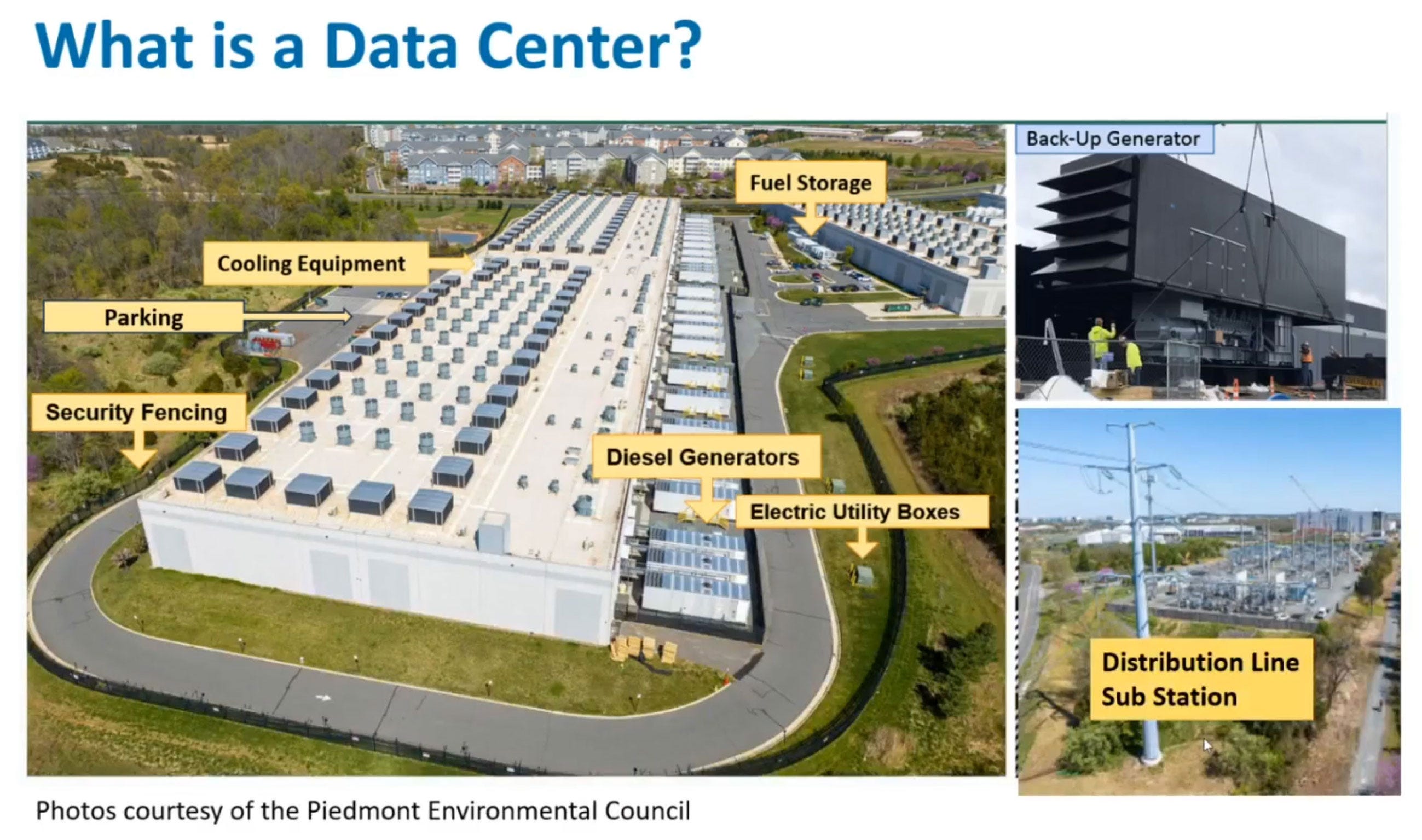
The graphic of a 80-megawatt data center that was shared at the beginning of your presentation was fantastic, and I’m including it in this piece for my readers (above). It effectively illustrates the massive scale of these operations: extensive cooling equipment on the roof, large fuel storage tanks, and backup diesel generators that was described as “big as a train car.’ It also shows a photo of the transmission lines, distribution lines, and substations required to keep the facility connected to the grid.
Because the equipment generates a tremendous amount of heat, it must be cooled constantly to prevent the servers from failing. Since there are several different cooling methods used in these data centers—such as air-cooled, open-loop, closed-loop, and direct immersion—could you explain for my readers on how those different approaches work?
Right now, my understanding is that closed-loop systems are a growing part of the market, maybe about 10% plus.
Note: In closed-loop systems, the coolant is continuously pumped through a sealed network of pipes. It flows in, absorbs the massive heat generated by the servers, carries that heat away to a chiller, and then the same exact fluid is recirculated back.
The market is still predominantly open-loop systems or air-cooled. Here in Frederick County, we were just told by Amazon that at least one of their facilities will be using air cooling.
The thing about closed-loop is that it minimizes the evaporative process, which reduces the requirement for putting more water or fluid into the system by a significant amount—anywhere between 75% to 90%. However, when you have a closed-loop system, the pumping is more aggressive, so the energy use goes up. It can actually add 10% to 15% to the total energy footprint of the facility. Compared to open-loop, it’s more significant.
There’s no one “right” way for any area. It depends on what resources you have, how abundant they are, how restricted they are, the associated costs, and what makes the most sense. It’s very location-specific. In general, would we like to see more and more closed-loop? Sure, but we have to recognize that moving in that direction consumes more energy. The same is true for air-cooled. Federal research is being done to examine what can be done to lessen the amount of additional energy required.
I think Loudoun Water noted that hyperscale data centers are using approximately half a million gallons of water a day. That’s a crazy amount. But, so too is the energy demand. Something you said during your presentation that I thought was interesting is that any improvements to data center efficiency are just being overtaken by the growth of AI.
Yes. We did a piece in the Maryland Data Centers Analysis Group about “Jevons Paradox.” It’s a business principle where, as a technology gets more efficient and costs go down, demand can actually outpace the savings achieved in energy. Because AI is relatively new and you have a lot of startups, more players can enter the market to offer different kinds of services. Demand right now is overtaking the efficiency savings we’re achieving in energy. Hopefully, the market will balance out, but knowing the timing of when that shift occurs is difficult.
I also did not know that additives are introduced to the water—biocides, corrosive inhibitors, heavy metals—that are picked up during the cooling process.
Yes, eventually in a closed-loop system, you have to dump that corrosive wastewater out. How are they going to handle that? It’s the same thing I say to people who say, “We don’t want diesels, we want battery storage.” Okay, but batteries leak, they have a lifecycle, and when they reach the end of life, where are the recycling facilities? These are massive battery systems. Do we have the facilities to recycle all these dangerous chemicals and materials at the end of their life? I’m not against battery storage, I’m just saying let’s look at the entire lifecycle and make sure we’ve invested and prepared to handle all implications. The same goes for wastewater disposal and the water that has to be reintroduced.
Are you recommending on-site treatment plants?
I don’t think we explicitly recommended that in our presentation, but how to handle drought restrictions is another major factor.
I was in a meeting the other day where they were talking about trucking water out of systems because the infrastructure wasn’t there. When you start looking at those kinds of things, you’re looking at burning fossil fuels for transport—a whole other environmental impact. All these things can’t be looked at in isolation. Every project has its own unique configuration. They replicate to some degree, but local conditions always make it play out differently.
Loudoun County is using reclaimed “gray water” now. They built infrastructure for data centers in 2015.
We looked at that and discussed the use of gray water and our wastewater treatment facilities here in Frederick County, and all the implications of that for our infrastructure. The Potomac River system has its own challenges, especially during drought years. You have to factor in droughts and everything else.
In Frederick County, because the aluminum smelting plant closed, we actually weren’t utilizing all of our electric capacity by a significant amount. Initially, the thinking was, “Oh, data centers won’t be a problem because we have the capacity and we’re under our usage.” Well, guess what? Now we have all these data centers coming, and that capacity is going to go quickly.
A comment Mike Turner made about hyperscale data centers really stuck with me. To paraphrase, it’s like we’ve built the airplanes without building the airports—meaning we’ve developed the data-intensive technologies without building the infrastructure.
When I spoke to the individual convening the working group in 2023, I asked him, “Do we understand the technology cycle for these data centers?” If we overbuild and these companies just leave (because new technology changes the economics) — we’re talking about massive amounts of money and huge buildings, and I have witnessed this in other industries—they could just walk away. It becomes a stranded asset. Then the county is left with this behemoth building. What other industry is going to want to take that over?
How do we restore or reclaim that area so it’s workable again? I talked about a phased approach: don’t overcommit to this technology because the industry is moving toward a smaller footprint. Investors would prefer to get the same output from a smaller footprint because all the upfront costs (land, resources) are lower. The industry will push in that direction because operating costs are currently so high.
We should be thoughtful about this, because if we overbuild, in 10 years we could have a lot of huge, abandoned buildings. When you ask the industry, “Would you redevelop that building or knock it down and do something smaller?” The answer is no, they’re going to go start fresh in a new place. So there really is this potential for abandoned sites.
I recommended requiring some kind of escrow account—something that either brings the industry back to the table to say, “Together, how do we prepare this site for redevelopment?” or at least provides the county government with funds to mitigate those sites.
You can look up the concept of “Black Sunday” in Colorado in the early ‘80s. That’s when a massive oil shale demonstration project was suddenly abandoned overnight by Exxon when oil prices dropped. They just walked away. Thousands of workers were left jobless, and the Governor of Colorado, Richard Lamm, only found out because news trucks were parked in front of the mansion on a Sunday morning. They didn’t even warn the governor. It created an immediate homeless problem as workers poured into Denver. There is serious money involved, and if the investment profile looks better elsewhere, they will up and leave.
I’m not saying we are going to have something like that, but if the investment profile is better over there than in this area...
Supporters of data centers have emphasized the potential for enormous tax revenue, but I don’t see how that revenue can be guaranteed.
I said in a meeting yesterday that not all jobs are created equal. When they say a project will bring 1,000 or 600 jobs, the construction jobs aren’t going to last. The remaining jobs—are they 1099 contractual roles where you could be gone the next hour, as opposed to full-time jobs with benefits? Who says people are going to relocate to your county for those jobs? They might be remote, or workers might commute from elsewhere.
That’s true.
A lot of the tax discussion is reasonable, but there’s stuff around the edges that is dubious at best.
What do you recommend for the emissions, since they appear to be primarily using diesel generators?
It would be better if we saw counties asking for the most efficient, highest-tier performance generators. But despite what the governor’s legislation says, counties should be creatively asking, “Hey, can 50% of this emergency generation be renewables, like battery storage?” Why does it have to be all or nothing? Why can’t it be configured where some of it is offset by battery storage?
And the generators only kick on when they lose power, correct?
Mostly, but they also do regular, cyclical testing. The worst pollution effects from anything running on diesel—even a car—are at startup and while idling. That quick startup and the short time frame they run on is the dirtiest combustion level the diesel will operate at. Of course, there needs to be air monitoring. We should be doing air monitoring now to establish a baseline, so we understand what happens once they operate. There are all kinds of baseline information that we should be gathering now.
For instance, we took a field trip to Loudoun County focused on an overview of their development. Someone took the opportunity to measure the noise. We stood on the fence line of a data center, right across the street from expensive houses, and someone took a reading on their phone: 88 decibels. You shouldn’t be living near 88 decibels. And it wasn’t even just the data center—it’s the traffic, the congestion, all the surrounding activities. You have to factor all of that in. You can tell a data center they can only output 60 decibels, but what are people actually living with when you add in all the other noise?
At a recent public hearing, someone claimed there has been a spike in health issues in Loudoun County connected to data centers. Have you seen any verified data?
You hear all kinds of stories. There are people that—and I think personally I would be susceptible to that—deal with that constant humming sound. People have moved from sleeping in their upper floors to creating basement bedrooms to avoid hearing it, or being kept awake by, that constant sound you get out of the data center, which doesn’t really stop.
That’s what I think people have a hard time envisioning or imagining. I’ve lived in places where there’s noise, noise, noise, but there’s always a period of the day when it stops. You can live on a busy thoroughfare, but at 2 o’clock in the morning, it’s not the same noise level as rush hour. But this is constant. There’s no letup. That’s a whole other effect.
I don’t think we even know what it means if there’s a school nearby. We have a situation where we have an elementary school with special education programs. What is that going to do to those children? We don’t know. What does it do to young children’s brain development? We don’t know yet. There are no longitudinal studies. We just don’t know.
As the interview wrapped up, Klareich offered one final caution about rushing the process: The lack of considering a visioning exercise, issue analysis, and ultimately a roadmap before setting policies is a major problem. You can replicate someone else’s policy structure, but how relevant is it to your needs? You’ve got to tailor it and customize it to the specific issues you’ll be facing.
“What do your policies incentivize and what do they penalize?” she added. “Keep in mind that innovation and emerging technologies typically are facilitated through incentive systems.”

Welcome to The Joy of Ptap. I live near Patapsco Valley State Park and share weekly stories from the park and surrounding communities: Catonsville, Ellicott City, Elkridge, Woodstock, and Granite. Subscribe for free or become a paid subscriber to get new posts delivered straight to your inbox.
unfortunately they've already rushed the process. my CSA farmer (One Straw Farm) in northern Baltimore County just posted a clip of the noise near their farm. they are also the oldest and largest organic farm in Maryland and I'm wondering how the diesel fumes will affect their crops.
residents should not have to soundproof their homes and properties or buy decibel meters so the rich can extract more wealth from our declining health.