


I’m a local writer sharing weekly stories from Patapsco Valley State Park and the communities of Ellicott City and Catonsville. Please consider subscribing to support my work.

I first heard of the Southwest Visions Foundation (SWVF) through its work improving pedestrian safety near Arbutus Middle School. Beyond that, I knew little about the organization until a recent public meeting, when Councilman Pat Young announced plans for the county to take the long-vacant Catonsville Armory from the state and transfer it to a nonprofit, SWVF.
The armory is no easy project. The building reportedly has a long list of issues, including asbestos, lead paint, diesel residue, basement flooding, and possible environmental contamination—so serious that both the county and state declined to take it on, unwilling to assume the liability. SWVF, however, has stepped forward with plans to transform it into a community asset, overseeing visioning, public engagement, and coordination with local and state officials.
Jay Dillow, SWVF’s president, stood up that night and introduced himself. He explained it was a long journey that got him to this point.
This week’s story is about Jay Dillow, and about the foundation he leads.
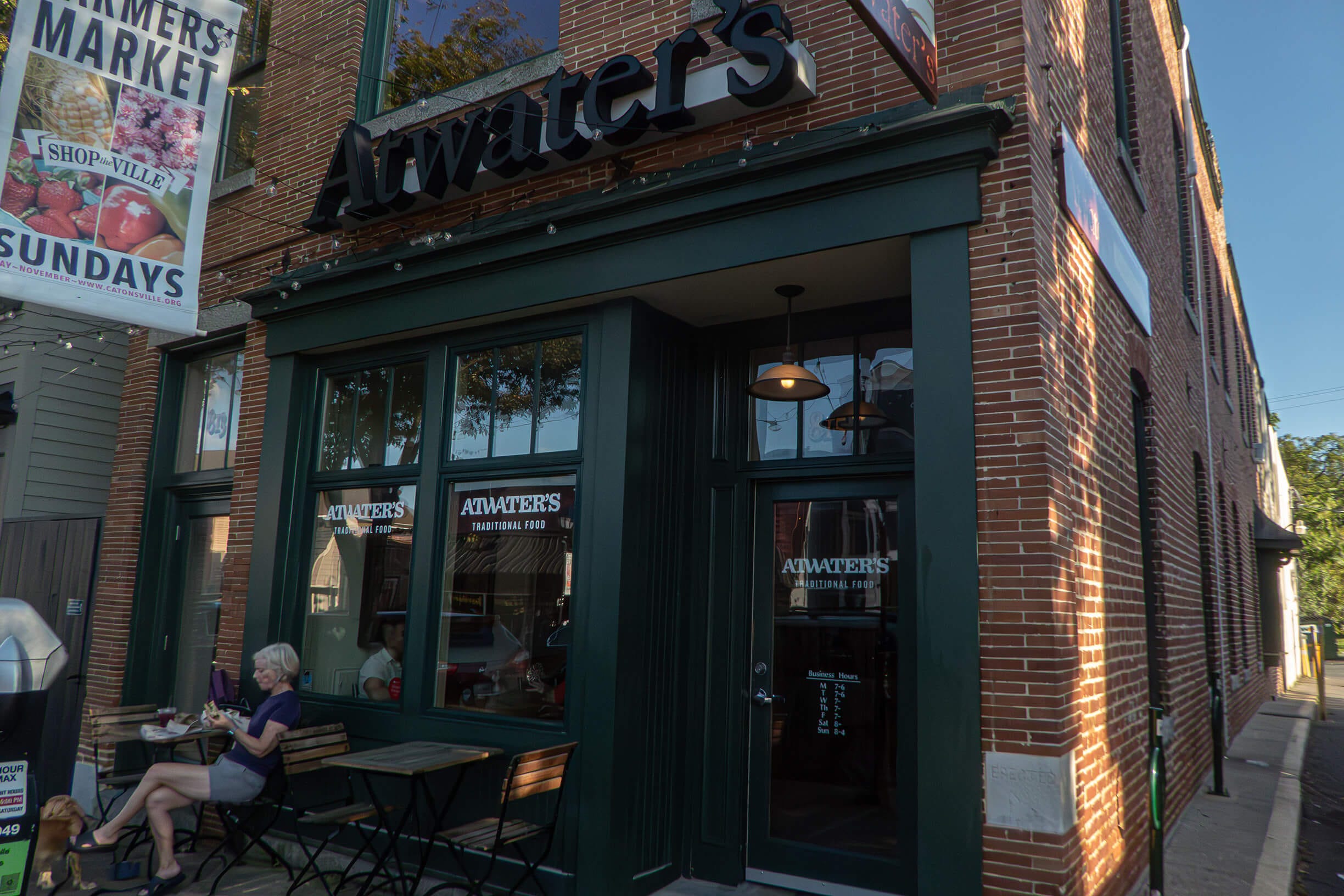
We met for coffee at Atwater's in Catonsville. “I was surprised you knew anything about us,” Dillow said. “Not a lot of people know about us. We’re a small volunteer board.”
He explained how SWVF got started. Fourteen years ago, Baltimore County delegate Jimmy Malone asked him and a UMBC representative to address community issues as the campus expanded. Dillow lived nearby.
“I’ve known Malone since I was a kid. He and my dad were firefighters together,” he said, pointing toward the old firehouse.
Working within a neighborhood relations group, they realized they needed a 501(c)(3) nonprofit to make progress, because as individuals, they couldn’t get anywhere. “So, we created a non-profit with folks from the business association. That launched Southwest Visions Foundation about five or six years ago.”
The first project they tackled was on Shelbourne Road. Dillow’s children went to Arbutus Middle School, and one of their friends had been hit while biking to school. The former principal, Michelle P. Feeney, kept track: at the time, an average of two to three kids a year were hit, mostly at the intersection by the church and cemetery.
“They had put in the rec center, the new library, and the senior center, with sidewalks all around, but then they abruptly stopped,” Dillow explained. “Kids were using the sidewalks as they were supposed to, and then suddenly there was a free-for-all trying to find a safe way to school.”
One board member, Nick Stewart, was heavily involved with the school system. Dillow brought the issue to him, and they started gathering the right players. When UMBC bought land from a church across the street, SWVF wrote a position paper outlining what needed to be fixed.
“We started tackling things one at a time,” Dillow said. “UMBC stepped in, and I need to give huge credit to our former executive Johnny O and Manny Reynolds. Now we have the pedestrian bridge. At the intersection of Poplar and Shelbourne, we worked with the county to get all the corners ADA compliant. If there isn’t an organization like Southwest Visions knocking on doors, it still wouldn’t be done. You’d be waiting forever. Unfortunately, that’s often how it works.”
Some safety issues along Shelbourne remain. The Cowdensville A.M.E. Church at the intersection of Shelbourne and Sulphur Spring was struck by vehicles three times in eight months. To address both protecting the church and getting kids to school safely, plans are underway to add sidewalks and a traffic circle, and Baltimore County has begun the process. “Maybe in the next two years, I can stop talking about Shelbourne,” Dillow said. “I’ve been talking about it for ten years.”
How does a small, volunteer-run nonprofit go from advocating for pedestrian safety to taking on a property like the Catonsville Armory? What convinced you to get involved in the Armory? How did this come about?
“There’s a very large nonprofit in Baltimore called Living Classrooms. They’re known for economic development and community work, and I was employee number 18. I had a long career there, working closely with our president and CEO, James [‘Piper’ Bond], who was like an older brother and mentor. We did a lot of cool projects together—everything from the Anacostia waterfront initiative to turning an island into Kingman Island Park.”
“In that role, I saw a lot. One day, the Boys & Girls Club on Lombard Street literally got shuttered. They’d gone bankrupt, and kids were standing outside waiting to get in when the mayor called James, our CEO for help. Suddenly, we were figuring out how to run a youth center. And we realized we could make it bigger and better for the community. I wound up involved in a lot of projects like that. That’s the theme Southwest Visions has taken on—stepping in where there’s both a need and an opportunity for the community.”
“So when I got invited to one of the Friends of the Catonsville Armory meetings, I looked around the room and thought, ‘Why am I here?’ Then it clicked. Listening to the discussion, I realized if no organization stepped in, the property would end up in the state surplus process. And once something lands on that list, it can sit for years. And ultimately it would end up in somebody’s hands who wouldn’t put community first. Now, we don’t know that for sure, but the reality is, probably. If you look at what happens to surplus property around the state, that’s typically what happens. A developer comes in, but the one piece that’s always lacking is the community.”
“The state had no interest in keeping it. They asked other agencies and universities—everyone said no. The county didn’t want it either. So basically, everyone was saying no. What was really needed was a community-based organization with good relationships at the state and county level, and some experience with the funding channels that support these kinds of projects. That’s where our background lined up. It’s a very unique skill set. You need someone who can handle the management and acquisition of an old building, then take it through a construction project to make it something community-based, potentially.”
Dillow added that Southwest Visions is also tackling another project: “This past session we secured $700,000 in a legislative bond initiative to work with a team of developers on revitalizing the East Drive Shopping Center in Arbutus—you know, where the Save A Lot and Dollar General are. A group of Baltimore County–based developers bought it a few years ago, and they want to reactivate the second floor, which for years was office space. We’re exploring partnerships with community organizations, potentially even UMBC, to rebrand it and call it Arbutus Marketplace.
“But once again, Southwest Visions asks, how can we help? Everyone’s first response is, oh, we need funds. But how are those funds used? We want to make sure the dollars serve the community.”
The Catonsville Armory project is still wide open. “We have no idea what it’s going to cost, and we’re bringing in someone for an initial assessment to see if the building can even be saved,” Dillow said.
Community interest has been tremendous. “Everybody’s got ideas—some even sent full-blown proposals,” he said with a laugh. “I appreciate the energy. Most people want it to be a community asset.” SWVF plans two community input sessions, with board members helping facilitate. “It’s a place where everyone should say what they want to say.”
“At the library meeting, people were frustrated and felt truly ignored,” Dillow said.
He noted that the delegation got their 'knuckles wrapped a little.' That same delegation has jumped in, working hard to make things happen.
At the September 4th public meeting at the Baltimore County Arts Guild, Councilman Pat Young said a group of folks from the first library meeting had formed the Friends of the Catonsville Armory. Young noted that the group is open to all, though some residents said they were unaware of the group or its meetings.
Dillow explained that the early Friends meetings were about getting the building off the state surplus list—not planning its future. “There are no plans,” Dillow stressed.
“People often ask how I could take on a project with no plans,” he said. “To me, it is a potential community asset, and if we [SWVF] didn’t step in, it might be lost to the community.”
Financing will be another challenge. Even with the General Assembly’s support, funds don’t flow immediately. “What will be needed financially is the state’s help and the county’s help, and those all fall under budget cycles. The money approved in April doesn’t actually show up until the following January or February, if you’re lucky,” Dillow explained. “So realistically, this will take multiple funding cycles—unless a benefactor steps in with a big check.”
Rehabilitation costs are another unknown. Earlier reports pegged renovation costs at $11 million, a figure repeated widely in the press. But, Dillow said, that number appears to have been little more than an estimate and not based on any real assessment. “When [Councilman] Pat [Young] asked for the report behind that number, nothing was produced,” he said. “A number that somebody two county executives ago in their office pulled out of the air.”
What matters most, he emphasized, is keeping the community engaged. “This project is going to be a marathon, not a sprint. The biggest challenge was getting people to feel like they were part of something. People felt ignored. Now they’re showing up and having their voices heard. The energy is positive. That’s the difference.”
When I asked if there really is a pool of water in the basement, Dillow laughed. “I’ve seen it. It exists, it’s real—and it doesn’t smell good.”
As we were finishing up, he leaned back in his chair and said, “The only limitations are the ones you put on yourself. I truly believe that.
If I wake up every day and say, ‘Man, I can’t do the Armory,’ that’s just tough—it’s too hard. You can say that about anything. I know it’s going to be a tough project, but when I look back, I’m hoping it will be like, ‘We created something great for the community.’”
SWVF will hold two community input sessions to hear what residents would like for the Catonsville armory. Dates and locations haven’t been announced yet.